
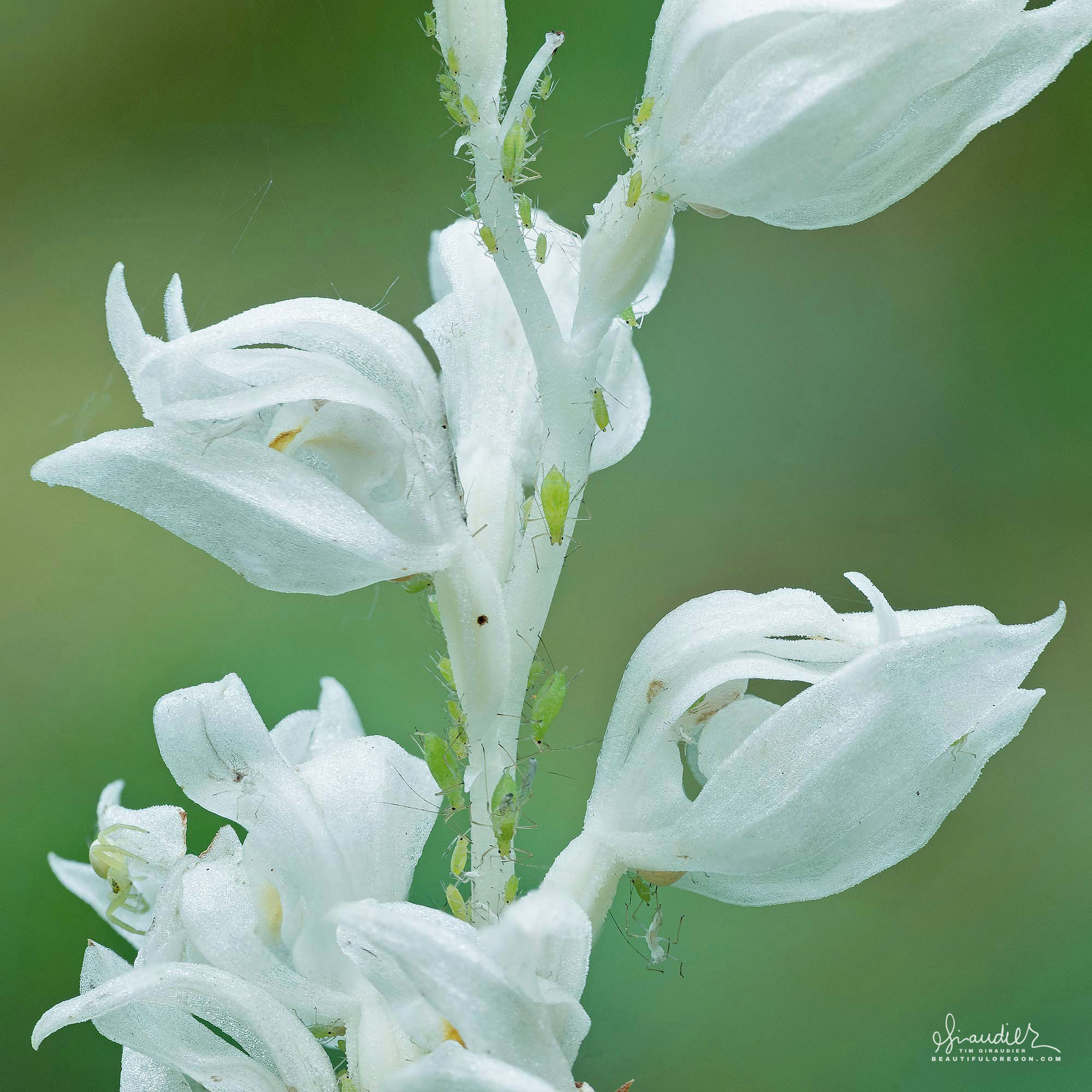
Phantom Orchid – Cephalanthera austiniae
$ 54.90
& Livraison gratuite plus de 60€In the hills not far from my house, I was exploring an old-growth forest of Douglas-fir and Western Hemlock, when I came upon a most interesting scene. Here, growing from a moist and cluttered forest floor, was an exquisite example of a mycoheterotrophic Phantom Orchid, being parasitized by an infestation of aphids. Let me explain! The Phantom Orchid (Cephalanthera austiniae) is a distinctive mycoheterotrophic perennial herb native to the temperate forests of the Pacific Northwest. Unlike typical plants that rely on photosynthesis for energy, the Phantom Orchid embodies a unique ecological strategy by deriving its nutrients through a symbiotic relationship with mycorrhizal fungi. This arrangement allows the orchid to thrive in shaded forest environments, where light is limited. Characteristically, the Phantom Orchid grows to heights of about 30 to 75 cm. Its pale, ghostly flowers, typically white to cream in color, often emerge from slender stems adorned with three to ten tubular blooms. The lack of chlorophyll is a defining feature, reflecting its adaptation to a lifestyle that bypasses traditional photosynthetic processes. The relationship between the Phantom Orchid and mycorrhizal fungi is pivotal for its survival. In this context, the orchid does not share nutrients or provide resources to the fungi; rather, it predominantly takes from the mycorrhizal networks established in the forest soil. These fungi connect the roots of the orchid to those of neighboring autotrophic plants, facilitating nutrient acquisition. The fungi, in turn, obtain carbohydrates from these plants, effectively linking multiple species in a complex web of dependency. The Phantom Orchid’s reliance on this network demonstrates a fascinating evolutionary adaptation to its ecological niche. Inhabiting mature coniferous forests, the Phantom Orchid prefers environments dominated by species such as Douglas fir (Pseudotsuga menziesii) and western hemlock (Tsuga heterophylla). These towering trees provide the necessary shade and moisture, crucial for the orchid’s growth. The rich organic matter and well-drained soils characteristic of these forests create an ideal habitat, further enhancing the interplay between the orchid and the fungal partners. Ecologically, the Phantom Orchid serves as an important indicator species, reflecting the overall health of its forest ecosystem. Its presence is often associated with biodiverse communities that support complex mycorrhizal networks. Since the orchid’s survival is sensitive to environmental changes—such as habitat loss, logging, and climate change—it underscores the need for conservation efforts aimed at preserving these intricate connections among forest life. Moreover, the Phantom Orchid contributes to maintaining genetic diversity within forest ecosystems. By interacting with various fungi and forming networks with different plant species, it plays a role in fostering resilience among community members. Through its unique mode of nutrient acquisition and its role within the forest ecosystem, the Phantom Orchid exemplifies the complexities of life in the Pacific Northwest. Its existence highlights the delicate interdependencies that define these rich ecological landscapes and serves as a reminder of the importance of preserving the intricate networks that sustain them. Aphids, Ecology, Insects, Orchid, Wildflowers