
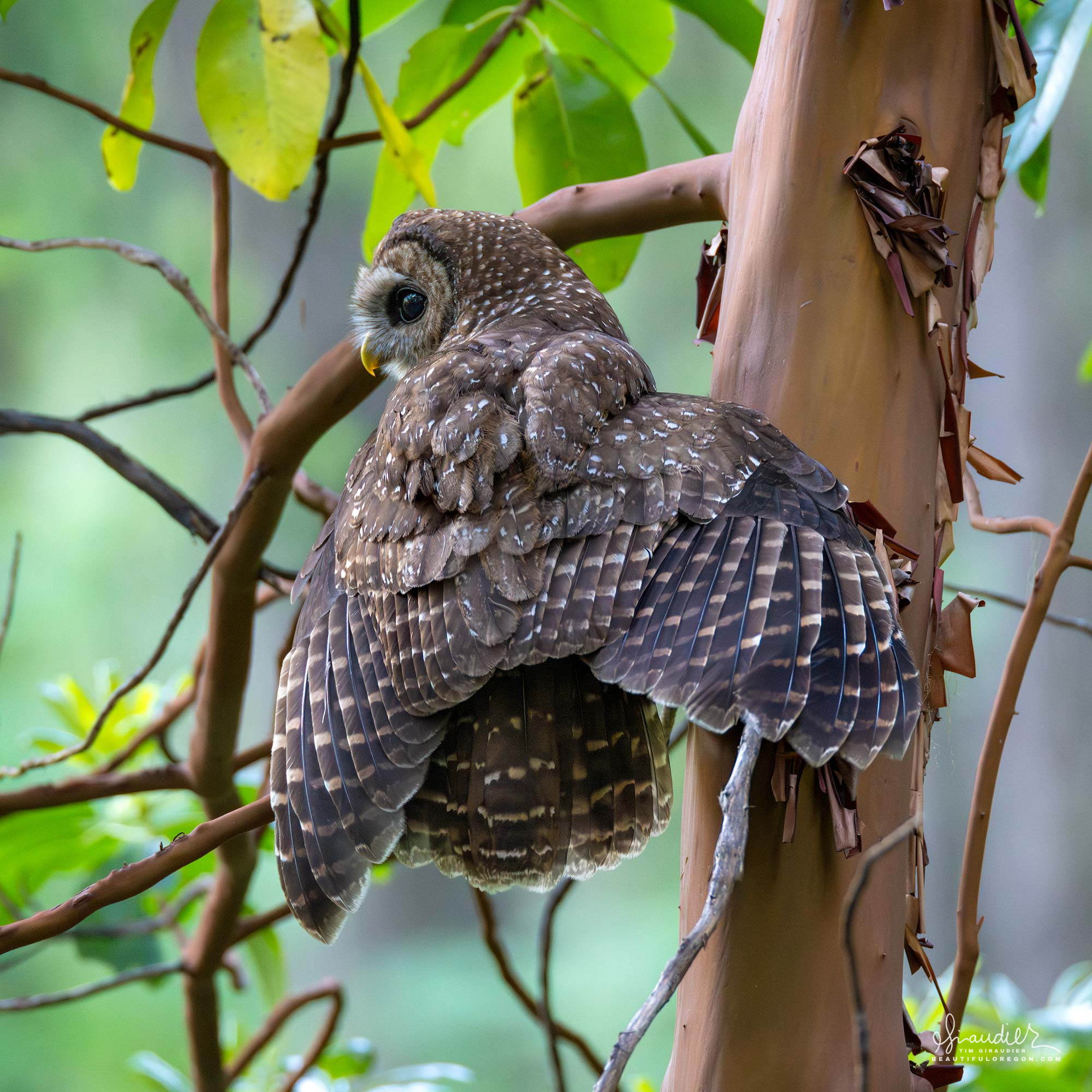
Northern Spotted Owl in Madrone Tree
$ 49.50
& Livraison gratuite plus de 60€A Northern Spotted Owl (Strix occidentalis caurina) perches in a Pacific Madrone Tree in the Siuslaw National Forest. Douglas County, Oregon Coast Range. The Northern Spotted Owl – A Symbol of Forest Ecosystems and Conservation Challenges: The Northern Spotted Owl (Strix occidentalis caurina) is an iconic species of the Pacific Northwest, its presence intertwined with the ancient forests that stretch across Oregon, Washington, and northern California. With its dark brown plumage, distinctive white spots, and large, soulful eyes, this medium-sized owl is both a striking emblem of the region’s biodiversity and a focal point of one of the most contentious environmental debates in the United States. Despite its ecological importance and protected status, the Northern Spotted Owl faces a precarious future, challenged by habitat loss, competition, and climate change. Ecological Significance and Habitat: The Northern Spotted Owl inhabits old-growth forests, relying on their unique structural complexity for survival. These forests, dominated by towering Douglas firs, western hemlocks, and redwoods, provide the dense canopy cover and abundance of prey species—such as flying squirrels and woodrats—that the owl needs to thrive. The species is highly specialized, preferring forests with large, mature trees, abundant deadwood for nesting, and open understories that facilitate hunting.This reliance on old-growth ecosystems makes the Northern Spotted Owl an indicator species, reflecting the health of the broader forest environment. Protecting this owl inherently protects countless other species, from understory plants to apex predators, highlighting its ecological significance. Habitat Loss and Fragmentation: The primary threat to the Northern Spotted Owl is habitat destruction caused by decades of logging. In the 20th century, the Pacific Northwest’s vast old-growth forests were heavily exploited for timber, reducing these ancient ecosystems to fragmented remnants. Although the listing of the owl as a threatened species under the Endangered Species Act (ESA) in 1990 led to significant reductions in logging on federal lands, private lands and some public forests continue to experience timber harvesting, further fragmenting critical habitat. Fragmented forests not only reduce the availability of suitable nesting and foraging areas but also isolate owl populations, making it harder for individuals to find mates and maintain genetic diversity. In recent decades, the Northern Spotted Owl has faced an additional threat from the encroachment of the Barred Owl (Strix varia), an invasive relative native to eastern North America. More adaptable and aggressive, Barred Owls compete directly with Spotted Owls for territory and resources. They are less dependent on old-growth forests, thrive in fragmented habitats, and often out compete or displace the more specialized Spotted Owls. Efforts to manage Barred Owl populations, including controversial experimental culling programs, have been implemented in some areas. While these measures aim to relieve pressure on Spotted Owls, they underscore the complexity and ethical challenges of wildlife management in a rapidly changing ecosystem. Climate change poses a long-term threat to the Northern Spotted Owl and its habitat. Rising temperatures, shifting precipitation patterns, and an increase in the frequency and severity of wildfires are altering forest ecosystems. These changes threaten to further degrade the owl’s habitat, particularly in regions already stressed by logging and invasive species. Wildfires, while a natural part of forest dynamics, have become more intense and widespread due to climate change and decades of fire suppression policies. Large, high-severity fires can devastate old-growth stands, leaving behind landscapes unsuitable for Spotted Owls and other species that depend on mature forests. Efforts to conserve the Northern Spotted Owl have often placed the species at the center of a polarizing debate between environmental protection and economic development. The restrictions on logging that followed the owl’s ESA listing significantly impacted timber-dependent communities, fueling resentment and opposition to conservation measures. Even today, proposals to loosen protections for old-growth forests continue to spark conflict, as stakeholders weigh the economic benefits of logging against the ecological importance of preserving habitat. Despite these challenges, significant efforts are underway to protect the Northern Spotted Owl. Federal and state agencies, conservation organizations, and researchers are working to restore old-growth habitats, manage Barred Owl populations, and monitor Spotted Owl populations. Programs like the Northwest Forest Plan, adopted in 1994, have played a critical role in preserving large tracts of federal forestland, ensuring a baseline of protected habitat. Innovative approaches, such as habitat restoration projects and community-based conservation initiatives, offer hope for balancing ecological needs with economic concerns. Increasing public awareness about the importance of old-growth forests and the role of species like the Northern Spotted Owl can foster broader support for sustainable forest management. 5×7 notecards / greeting cards of this photograph are available in The Gift Shop. Douglas County, Owl, Pacific Madrone, Siuslaw National Forest, Spotted Owl
Produits similaires
-
Camera Canon ME20F-SHN $ 90.46