
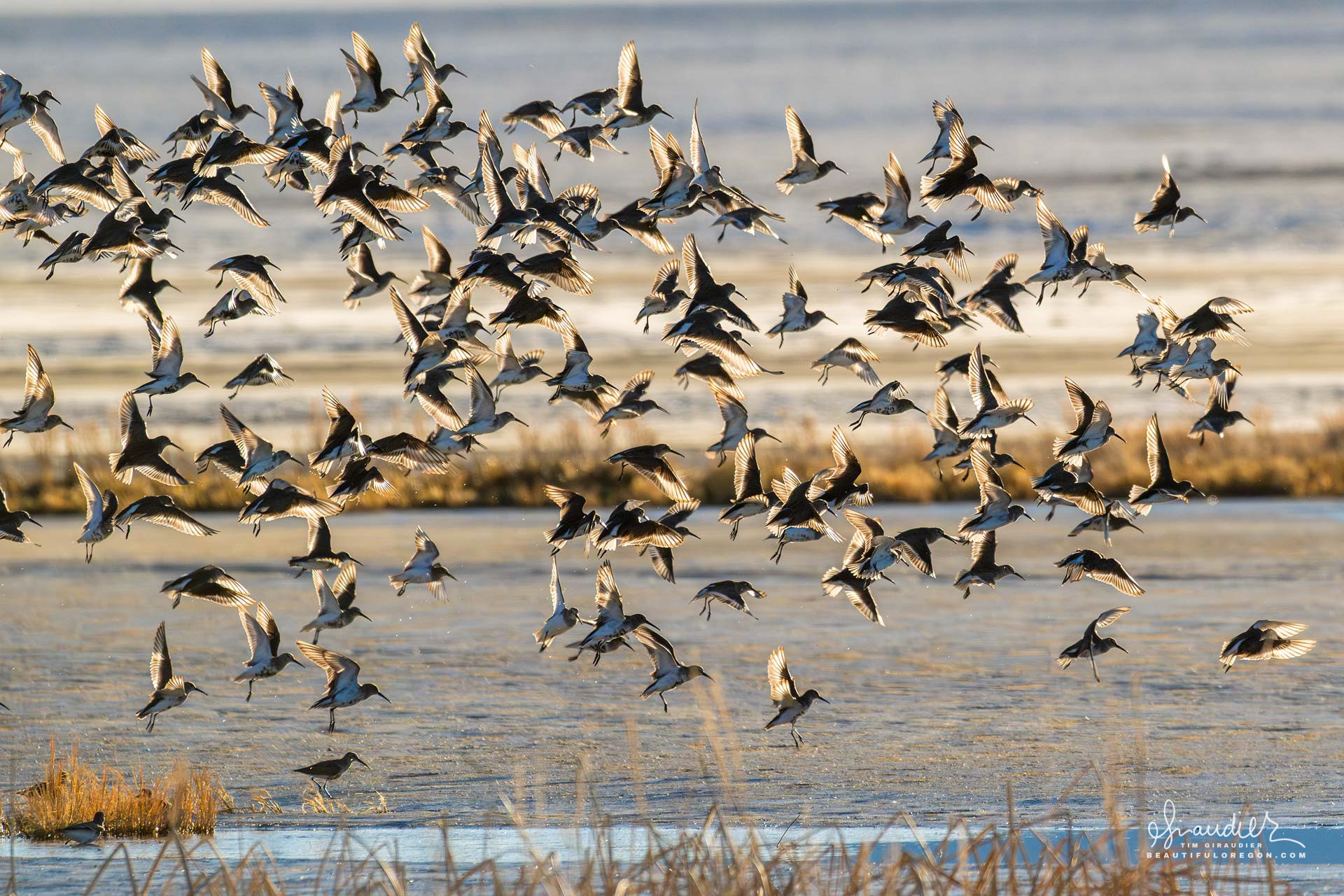
Dunlin shore birds of Oregon and the PNW
$ 49.50
& Livraison gratuite plus de 60€A large flock of Dunlin (Calidris alpina) bolts to the sky as they shift feeding locations across the alkali flats of Summer Lake. Summer Lake Wildlife Refuge, Lake County, Oregon. The Dunlin is a medium-sized sandpiper, frequently observed along Oregon’s coastlines and estuarine mudflats, particularly during the spring and fall migrations. It is most commonly seen in large flocks on tidal flats and coastal wetlands such as those found in the Columbia River Estuary, Tillamook Bay, and the Siletz and Siuslaw river mouths. In nonbreeding (winter) plumage, which is typical for Dunlins observed in Oregon, adults display grayish upperparts, a whitish belly, and a slightly drooping black bill. In contrast, breeding plumage—less commonly seen locally—features a distinctive black belly patch, rusty back, and rufous crown. They measure approximately 17–21 cm in length with a wingspan of 32–36 cm. Dunlins forage by probing soft substrates with their bills, primarily consuming polychaete worms, amphipods, mollusks, and other invertebrates. Their migratory presence in Oregon supports important stopover ecology, linking Arctic breeding grounds with more southerly wintering sites as far south as Central America. Though not currently threatened, Dunlins are considered sensitive to habitat loss and degradation of alkali mudflats and coastal wetlands—making Oregon’s protected estuaries critical for their conservation during migration. Dunlin, Lake County, Southeast Oregon, Summer Lake
Produits similaires
-
CAMERA PTZ CANON CR-N700 NOIRE $ 99.61