
Crack in the Ground Christmas Valley
$ 49.50
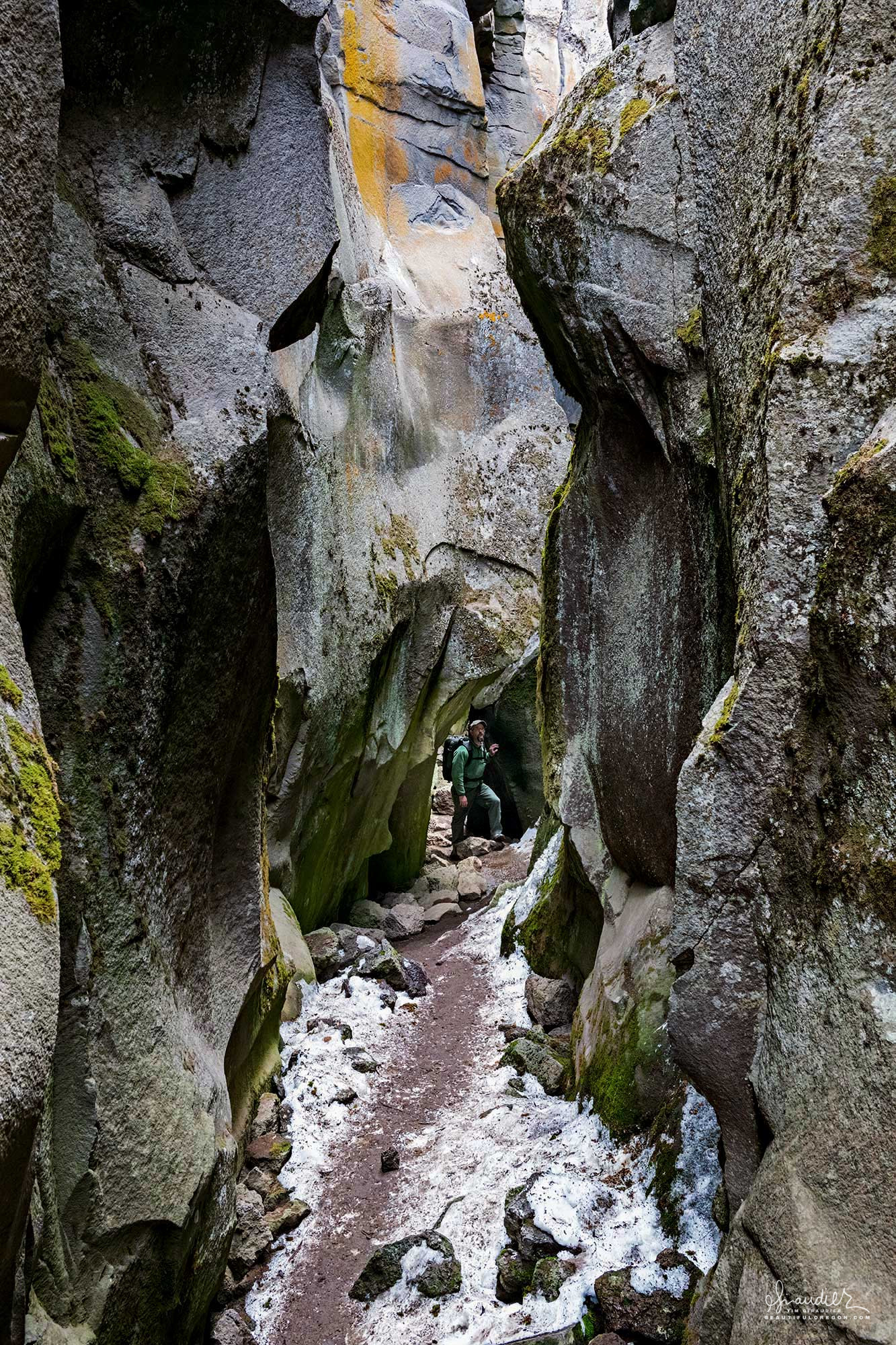
& Livraison gratuite plus de 60€Seven miles north of the small community of Christmas Valley, a fissure opens in the floor of the Oregon high desert with almost no warning. The landscape leading to it is characteristic of the region, sagebrush steppe rolling toward a low horizon, with juniper scattered across the volcanic plain, and then the ground simply splits. Crack in the Ground is two miles long, as much as seventy feet deep, and as wide as fifteen feet at the surface. In its narrowest sections, a person can touch both walls simultaneously with outstretched arms. The fissure sits within the High Lava Plains geologic province, an extensive swath of central and southeastern Oregon characterized by abundant volcanoes, lava flows, and ash deposits. Its formation is tied directly to volcanic activity at the Four Craters lava field immediately to the north. When the Four Craters cinder cones erupted, they emptied an underground magma chamber, causing the overlying ground surface to sink and rupture along the edge of the valley. This produced a shallow, graben-like structure, a block of crust that dropped relative to the terrain on either side, and the tension fracture that became the Crack. Geologists have bracketed the fissure’s age by examining the volcanic record surrounding it. It must postdate the lava flows from nearby Green Mountain, a basaltic shield volcano that paved over the area roughly 740,000 years ago, and it must predate the Four Craters lava flows of approximately 14,000 years ago, which oozed over the existing edge of the Crack. Within that broad window, the feature is considered geologically young — a freshness confirmed by the fact that it remains open at all. Normally, fissures of this kind are gradually filled by erosion and sedimentation over time. At Crack in the Ground, the extreme aridity of the surrounding desert has slowed that process dramatically, leaving the feature today nearly as it appeared shortly after its formation. Windblown sand continues to accumulate along its floor, and future seismic activity could eventually deepen the burial of its downthrown side, but for now, the Crack endures as a rare example of a geologic feature preserved close to its original state. The human history of the surrounding basin is considerably longer than the fissure itself. The region had long been home to bands of the Northern Paiute, who moved through the landscape seasonally, gathering edible plants, hunting game, and periodically holding communal jackrabbit drives that served both as food procurement and as inter-band social gatherings. Each band occupied a territory generally centered on a lake or wetland, moving in small, independent family groups that followed animal migration patterns and the availability of seasonal foods. Whether the Northern Paiute made specific use of the fissure is not documented, though as hunters moving across this terrain, they almost certainly knew of it, and the temperatures inside the crack, which can run twenty degrees cooler than the surface above, would have offered relief during the intense heat of a high desert summer. Euro-American settlement came to the Christmas Lake Valley in the 1870s, initially as open range for cattle grazed by ranchers working out of neighboring valleys. The valley’s name carries its own quiet history: the area took its name from a cattleman named Peter Chrisman, who built a cabin near a seasonal alkali lake around that time. What was recorded as Chrisman or Christman Lake had become Christmas Lake by 1877, through a spelling drift that eventually fixed itself permanently into maps and local usage. The Crack itself is now managed by the Bureau of Land Management and is accessible via a short trail from a trailhead at the end of Crack in the Ground Road. The hike follows the fissure’s floor for its full two-mile length, through chambers that widen and narrow unpredictably, past small caves, and under walls of dark basalt that close out much of the sky above. It is a place that the surrounding desert gives no indication of until a person is standing at its edge. Crack in the Ground — Christmas Valley, Lake County, Oregon Christmas Valley, Crack in the Ground, Lake County, People, Trail
Produits similaires
-
Camera Canon ME20F-SHN $ 90.46