
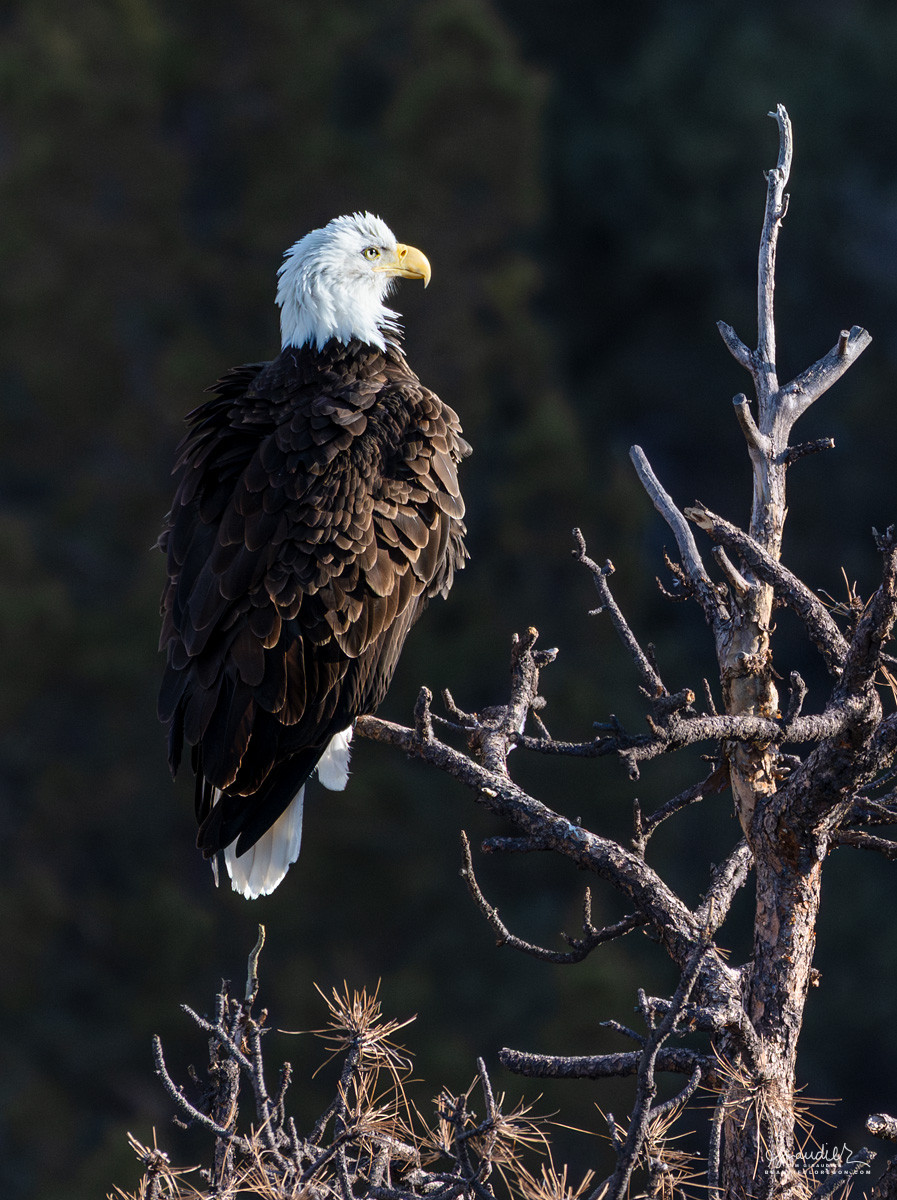
Bald Eagle – Pacific Northwest High Desert
$ 49.50
& Livraison gratuite plus de 60€With a commanding view of the Crooked River, a female Bald Eagle (Haliaeetus leucocephalus) roosts and preens herself atop a dying pine tree. Her nest is forty feet up in a Ponderosa pine that anchors itself into a narrow ledge partway down the canyon wall. The tree is old and broad-shouldered, its bark plated in warm orange and cinnamon, and the nest occupies the first major fork below the crown — a platform of sticks built up over 14 seasons now into a structure nearly eight feet across. She is at the threshold of full adulthood, four or five years old, her head broadly and cleanly white, her eyes the pale yellow of a mature bird. But trace the length of her tail and you will find the last remnant of what she has been shedding since her first molt — a scattering of dark brown flecks near the base of the rectrices, one final season’s worth of transitional plumage. One more complete molt will erase it. For now she carries both worlds in a single body. Last year she and her mate had gone through the full ritual of pair bonding and nest preparation along this same stretch of river. They had soared together in tight formation above the canyon rim, locked talons in the cartwheeling display, copulated repeatedly, and renovated the Ponderosa nest with fresh material. And then nothing. No eggs. First and second breeding attempts among bald eagles frequently end this way, the hormonal architecture for successful laying not yet fully organized, the pair still calibrating to one another. She was not a failed mother. She was an inexperienced one. A female bald eagle hatches after approximately 35 days of incubation, blind and covered in pale gray down. She is entirely dependent on both parents for thermoregulation and food delivery for the first several weeks. Pin feathers emerge within the first month, and by ten weeks the nest is crowded with a bird approaching adult size but still wearing the dark juvenile plumage that will define her appearance for the next several years. Fledging typically occurs between 10 and 14 weeks post-hatch. First flights are clumsy and short, and the young bird remains within the vicinity of the nest tree, returning to be fed by adults for several weeks after initial fledging. By late summer or early fall of her first year she becomes nutritionally independent, though her foraging efficiency is poor relative to adults. Juvenile bald eagles suffer high mortality in this period. Starvation, trauma from failed hunting attempts, collisions, and in some regions lead poisoning from scavenged carcasses containing spent ammunition, all take a significant toll. Survivorship estimates for first-year birds range considerably across studies, but mortality rates of 50 percent or higher in the first year are not unusual. Those that survive do so largely through behavioral flexibility — scavenging opportunistically, following older birds to food concentrations, and avoiding energetically costly pursuits with low probability of success. She enters her second year still in heavily mottled brown and white plumage, the pattern variable enough that aging individual birds requires attention to multiple features simultaneously — the extent of white on the underwing coverts, the degree of streaking on the breast, the color transition on the bill and cere. Her range during these subadult years is broad and not yet fixed to a territory. Bald eagles in their second and third years are frequently documented far from natal areas, and some undertake extensive movements following seasonal food availability. She is physiologically capable of long distance flight and has the soaring and maneuvering skills of an experienced bird by her second or third year, even if hunting proficiency continues to improve with age. Plumage transitions proceed through a series of annual molts. The classic white head and tail of the adult bird are typically fully expressed by the fifth year, though there is individual variation in the timing. Some birds show nearly complete adult plumage by year four, while others retain traces of dark mottling into their fifth or even sixth year. The female shown in this photograph, with brown flecks persisting at the base of the rectrices in her fourth or fifth year, falls within the normal range of this variation. Sexual maturity is generally reached between four and six years of age. Females do not typically begin breeding at the earliest possible age, and first pairing attempts often precede successful reproduction by one or more seasons. The pair bond in bald eagles is characteristically long-term, with paired individuals returning to the same nest site across multiple years. Nest construction and renovation begins weeks before egg laying and appears to serve a pair-bonding function in addition to its structural one. Copulation occurs repeatedly over a window of several weeks prior to laying, and clutch size is typically one to three eggs, with two being most common. First and second breeding attempts frequently fail to produce eggs, or produce eggs that fail to hatch. The causes are multiple — insufficient hormonal coordination, nutritional status of the female at the time of follicle development, disturbance at the nest site, and simple inexperience in nest attendance and incubation behavior. Productivity among established pairs of known age increases measurably after the first successful breeding attempt, suggesting a learned component to reproductive success that operates alongside physiological maturation. A female who fledges successfully, survives the high-mortality period of nutritional independence, establishes a home range with adequate food resources, pairs with a compatible and experienced mate, and successfully incubates and broods a clutch to hatching may accomplish all of this by her fifth or sixth year. The interval from hatching to first successful brood is therefore typically no less than five years and may extend to seven or beyond depending on individual circumstance and environmental conditions. It is a slow life history by the standards of most birds, offset by a potential lifespan in the wild exceeding twenty years and the capacity, once established, for high annual reproductive output across many consecutive seasons. The lower Crooked River canyon sits within a broader landscape that supports one of the more significant bald eagle populations in the contiguous United States. The Pacific Northwest — spanning the coast, the Cascades, and the high desert interior — provides the combination of large water bodies, abundant fish, and undisturbed nesting habitat that the species requires. Wintering concentrations form each year along major river systems such as the Skagit, the Columbia, and the Klamath, where spawned-out salmon provide a reliable and dense food source. Breeding pairs are distributed across the region from coastal British Columbia south through Washington and Oregon, with interior river corridors like the Crooked, the Deschutes, and the John Day supporting resident nesting populations year-round. The recovery of bald eagles across the Pacific Northwest since the ban on DDT in 1972 and their removal from the federal endangered species list in 2007 represents one of the more well-documented conservation successes of the past half century. Aerial survey data from Oregon and Washington indicate continued population growth and range stability, though localized threats including lead exposure, habitat disturbance near nest sites, and collisions with power infrastructure remain active management concerns. Bald Eagle, Central Oregon, Deschutes County, Oregon State Parks, Smith Rock State Park
Produits similaires
-
CAMERA PTZ CANON CR-N700 NOIRE $ 99.61