
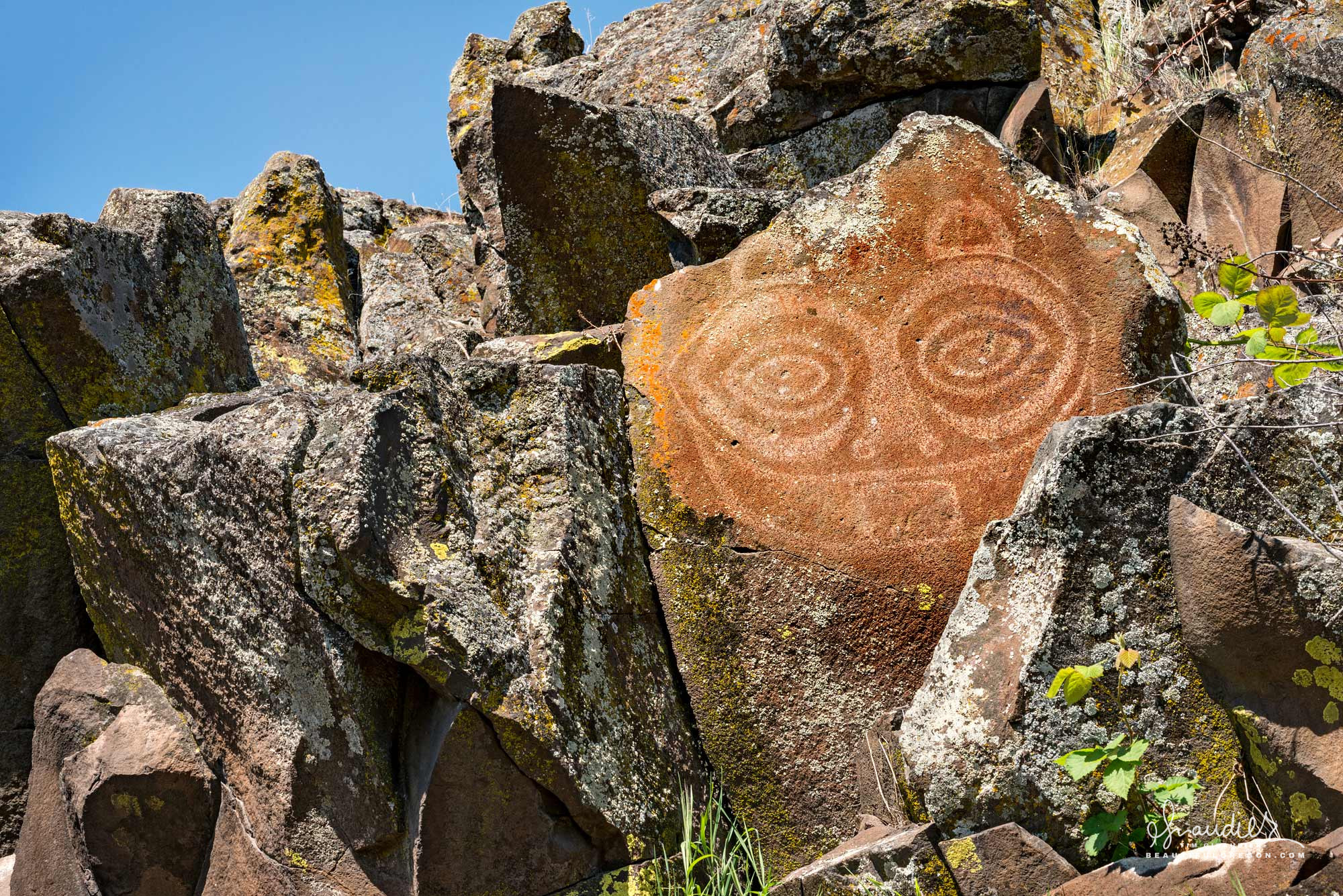
Tsagiglalal She Who Watches
$ 49.50
& Livraison gratuite plus de 60€Tsagiglalal, “She Who Watches” still looks out across the Columbia River from the basalt cliff where she was painted by Chinookan People somewhere between the years 1700 and 1840. This spectacular pictograph was created using mineral pigments pulverized from rock. In contrast, much of the historic Native American artwork found at this important site has been carved into stone, an art form known as a petroglyphs. The petroglyphs found here were originally carved upon the nearby cliffs of Petroglyph Canyon, which was submerged by the reservoir created by The Dalles Dam in 1957. Also submerged by the Dalles Dam was Celilo Falls which was located directly in front of this site. The [She Who Watches] pictograph is part of the greater Temani Pesh-wa (Written on Rock) trail, which at the behest of the Nez Perce Tribe, the Confederated Tribes of the Umatilla, the Yakima Nation, and the Confederated Tribes of the Warm Spring was officially opened to the public in 2004. Access to this site is by guided tour only, and despite any inconvenience of signing up, it is both important to the protection of this site, and you will learn a great deal more about its history than if visited alone. Columbia Hills State Park, Washington State. If interested in blank greeting cards of this image, you can find them in my Note Card Gallery. Tsagiglalal: The Enduring Watcher of the Columbia Plateau On a basalt cliff above the Columbia River in present-day Washington, a wide-eyed face painted in red ochre looks steadily across the land. This ancient image is known as Tsagiglalal, or “She Who Watches,” one of the most renowned pictographs in the Pacific Northwest. For centuries, the eyes of Tsagiglalal have gazed out over the river, the villages, and the fishing grounds that sustained generations of Indigenous people. Today, the figure endures not only as an artifact of rock art but as a symbol of resilience, watching over the landscape through centuries of upheaval. Cultural Context and Origin The Columbia Plateau, stretching across Washington, Oregon, and into Idaho, has been home to Sahaptin-speaking peoples for millennia. Among these are the Wishram and Wasco, two Chinookan-speaking groups who lived along the river’s great rapids, and the Yakama, Umatilla, and other Plateau tribes who shared its fisheries and trade routes. The river was a lifeline, its salmon runs supporting some of the densest pre-contact populations in North America. Rock art—both pictographs (painted) and petroglyphs (carved)—was a central form of spiritual and cultural expression. Tsagiglalal belongs to this tradition. Painted on a vertical basalt wall, the figure consists of a round face with large eyes, a mouth set in an oval, and lines radiating outward that suggest both watchfulness and permanence. Oral tradition situates Tsagiglalal as a woman leader, transformed into stone so that she might continue to guard her people. She is said to have lived near the great fishing village of Nixlúidix, once a thriving community along the Columbia. The Legend of She Who Watches Among the Yakama and Wishram, stories recount that Tsagiglalal was a woman chief at a time when such leadership was possible. When Coyote, the culture hero of Plateau mythology, traveled through the land bringing change, he warned her that the world was shifting, and that people would no longer be led by women. She asked what would become of her people if she could not watch over them. In answer, she was turned into stone, her eyes forever open to watch the river and the lives that unfolded along its banks. This narrative reflects the profound role of Coyote in reshaping the world from its mythic to its human order, while also acknowledging a historic transition in Plateau societies. Whether understood as metaphor or memory, the story embeds Tsagiglalal in a deep continuity of cultural transformation, survival, and guardianship. Artistic and Material Aspects The pictograph is executed in red ochre, a pigment derived from iron oxide, mixed with a binder likely made from animal fat or plant material to help it adhere to stone. Ochre has been used by Indigenous peoples worldwide for tens of thousands of years, valued for both its durability and its spiritual potency. Despite exposure to centuries of wind, rain, and sun, the figure of Tsagiglalal remains visible, a testament to both the materials and the sacred care with which it was applied. The placement is also significant. She faces outward over a broad stretch of the Columbia River, a vantage point that once overlooked villages, gardens, and fishing sites. The Columbia Gorge was among the richest cultural landscapes in North America, and the presence of She Who Watches underscores the sacred bond between people, place, and the living river. Displacement and Preservation The modern history of Tsagiglalal is marked by upheaval. The construction of The Dalles Dam in 1957 inundated Celilo Falls and many of the villages and fishing grounds central to the cultures of the Columbia Plateau tribes. Countless petroglyphs and pictographs were lost beneath the reservoir. Tsagiglalal, however, survived above the high-water mark. Today, access is restricted and guided tours are required to view the site, both to protect the fragile pictograph and to honor its cultural significance. The Confederated Tribes of the Umatilla, Yakama, Warm Springs, and Nez Perce Nations remain central in safeguarding the site and telling its story. Continuing Meaning For Indigenous communities, Tsagiglalal is not a relic but a living presence. Her gaze affirms a relationship between land, people, and spirit that has endured despite colonization, forced relocation, and ecological loss. She embodies vigilance, memory, and continuity, reminding all who encounter her that the Columbia Plateau remains Native land, watched over since time immemorial. For non-Native visitors, She Who Watches offers a rare window into the deep histories embedded in the Gorge. Yet her meaning cannot be separated from the people who still claim her as kin and guardian. She is a call to remember that these lands are not empty scenic vistas but inhabited homelands where cultural life continues. Historic Oregon, Klickitat County, Native American, Petroglyph/Pictograph