
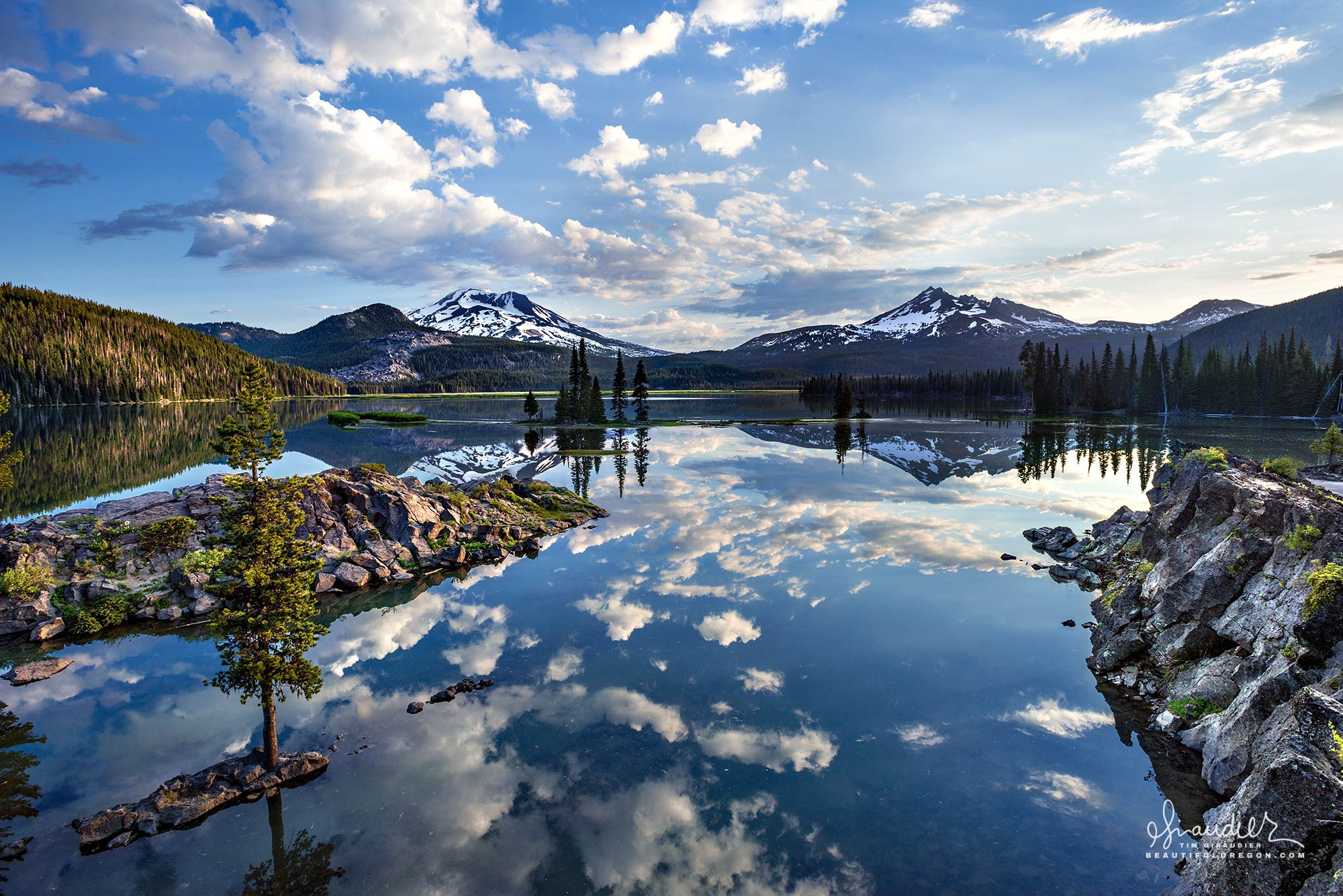
Sparks Lake Reflecting Blue Sky
$ 49.50
& Livraison gratuite plus de 60€A beautiful blue bird sky filled with white puffy clouds reflects from Sparks Lake, as Broken Top and the South Sister rise at the north end of the lake. Deschutes National Forest, Central Oregon Cascades. Geologic Formation and Lava Damming of Sparks Lake, OregonSparks Lake is a shallow, high-elevation lake situated at approximately 5,350 feet, on the east slope of Oregon’s Central Cascades, and immediately west of Mount Bachelor. Geologically, the lake occupies a volcanic basin formed by Holocene lava flows from Mount Bachelor and surrounding cinder cones. These basaltic and andesitic flows created a natural damming of alpine drainage, producing a broad, marsh-fringed basin with poor surface outflow. Sparks Lake lies within the High Cascades volcanic province and occupies a broad, shallow basin formed by Quaternary volcanism and subsequent lava damming. The lake basin was created during the late Pleistocene to early Holocene, primarily through eruptive activity associated with the Mount Bachelor Volcanic Chain, which includes a complex of basaltic to basaltic-andesite shield volcanoes, cinder cones, and lava flows. The specific damming of Sparks Lake occurred as a result of Holocene basaltic lava flows that issued from subordinate vents on the lower flanks of Mount Bachelor and adjacent volcanic centers, such as Kwohl Butte. These flows advanced across existing alpine valleys and glacially carved drainage networks, creating a natural impoundment on the east slope of the Cascade crest. The lava filled low points in the topography, forming a broad, uneven barrier that blocked the eastward flow of snowmelt and spring-fed channels originating from South Sister, Broken Top, and Mount Bachelor. The lava dam itself consists largely of porous pahoehoe and blocky basalt with localized zones of clinker and welded spatter. Because of the highly vesicular and fractured nature of this substrate, Sparks Lake exhibits significant subsurface drainage, with water percolating through lava voids and lava tubes. There is no established surface outflow. Instead, the lake gradually loses water into the surrounding lava flow, which in turn recharges the regional groundwater system—likely contributing to springs in the upper Deschutes River basin to the east. This interaction between volcanism and hydrology defines Sparks Lake’s ephemeral and seasonal nature. The landscape demonstrates the classic pattern of lava-dammed alpine lakes in the central Oregon Cascades, where lava flows post-date glaciation and modify glacial valleys into closed or semi-closed basins. Radiometric dating and stratigraphic evidence place the damming lava flows to within the last 10,000 years, though most are considered to be between 7,000 and 2,000 years old, making Sparks Lake a relatively young hydrologic feature in geologic terms. Hydrologically, Sparks Lake is primarily fed by snowmelt and seasonal tributaries draining the slopes of South Sister, Broken Top, and Mount Bachelor. Its porous volcanic substrate facilitates extensive groundwater infiltration, which serves as the lake’s primary mode of outflow—there is no persistent surface outlet. The lake is largely ephemeral in nature, experiencing significant seasonal fluctuations in both area and depth. During dry years, exposed lava and sediment flats can expand considerably. The lake’s shallow average depth (typically <6 feet) and broad wetlands contribute to high water temperature variability and support aquatic vegetation in summer months. The water is generally clear to slightly turbid depending on season and sediment input, with limited nutrient cycling due to its high elevation and low productivity. Sport Fishery: Sparks Lake is managed as a fly-fishing-only, catch-and-release fishery for Cranebow rainbow trout (a strain from nearby Crane Prairie Reservoir) and brook trout. Stocking occurs annually, as natural reproduction is negligible due to limited perennial stream inflow. The shallow structure and submerged lava features offer favorable sight-fishing conditions, particularly in spring and early summer before aquatic vegetation becomes dense. Anglers commonly target trout using dry flies during hatch events or subsurface patterns like leeches and damselfly nymphs. Float tubes and small watercraft with electric motors are commonly used due to the lake’s complex, marshy perimeter and shallow reach. Fishing conditions tend to decline by late summer as water temperatures rise and lake levels fall. Access is typically limited to the snow-free season, from late May to early October. Broken Top, Cascade Lakes Highway, Deschutes County, Deschutes National Forest, Lake, Sky Scape, South Sister, Sparks Lake
Produits similaires
-
Camera Canon ME20F-SHN $ 90.46
-
CAMERA PTZ CANON CR-N700 NOIRE $ 99.61