
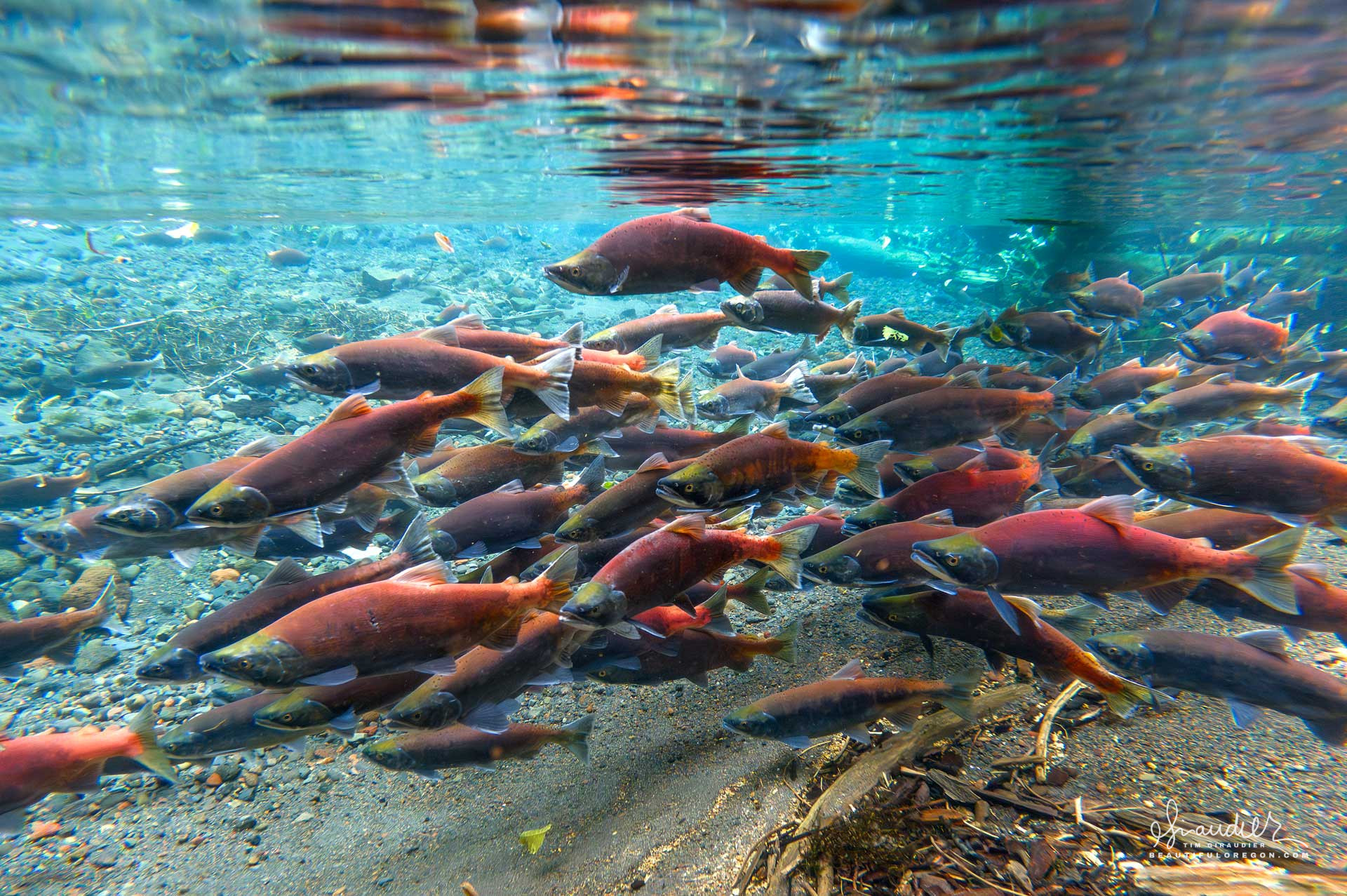
Kokanee Salmon Odell Lake
$ 49.50
& Livraison gratuite plus de 60€Kokanee, a landlocked form of Sockeye salmon, enter Trapper Creek, their natal spawning stream, and tributary to Odell Lake. Every year beginning around October 1st, I’ll make my way up to Trapper Creek to watch the Kokanee as they prepare to spawn. At this time of year, and certainly by the end of October, there will be a crust of snow along the riverbank, revealing who’s been down to the waters edge to catch an easy meal. The usual culprits include eagles ravens, raccoons and bear. Standing along the creek, you’ll quickly see the bright red and green of Kokanee sporting their spawning colors. The water is crystal clear, the fish easy to see, and the stream bed is comprised of rounded river rock, and the occasional orange-red of volcanic cinder. By early October, autumn is well underway along the highland crest of Oregon’s Cascade Mountains, and you’ re almost certain to find King Boletes, Lion’s mane, and a generous sprinkling of summers last huckleberry’s. Odell Lake, located within the Deschutes National Forest of central Oregon, supports one of the most robust wild kokanee salmon (Oncorhynchus nerka) populations in the state. Kokanee are the landlocked form of sockeye salmon, completing their entire life cycle within freshwater. In Odell Lake, these fish mature, spawn, and die entirely within the watershed, using both inlet streams and gravel shoreline areas for reproduction. This dual spawning strategy offers resilience, allowing kokanee to reproduce under a range of hydrological conditions. The spawning season for kokanee in Odell Lake occurs in the fall, generally from mid-October to early November. The onset of spawning is triggered by decreasing daylight and falling water temperatures. While some kokanee spawn along the lake’s shoreline on gravel substrates, the majority migrate into tributary streams, the most important of which is Trapper Creek, located on the lake’s northwest shore. This clear, cold stream offers well-oxygenated water and clean gravel ideal for spawning. Each fall, sexually mature kokanee, easily recognized by their crimson bodies, green heads and the males’ exaggerated dorsal humps and hooked jaws; gather in large numbers at the creek’s mouth and migrate upstream to excavate redds in the gravel. Spawning involves the female selecting and excavating a shallow depression in the substrate using vigorous tail movements. Males compete for access to these sites, often engaging in displays or brief confrontations. Once a female begins depositing her eggs, one or more males release milt to fertilize them. A single female can deposit several hundred to a few thousand eggs, depending on her size. Like other Pacific salmonids, kokanee are semelparous, meaning they die shortly after spawning. Their carcasses contribute organic nutrients to the stream and lake systems, supporting aquatic invertebrates, scavengers, and even terrestrial species like bald eagles and river otters. Kokanee also spawn along various shoreline segments of Odell Lake itself. These areas, when composed of clean, unconsolidated gravel and suitable water flow, provide alternative redd sites. This shoreline spawning is particularly important during years of low stream flow or restricted access to upstream habitat. It also helps spread reproductive effort across space, reducing the risk of failure due to local disturbance or poor conditions in any one location. Fisheries managers at the Oregon Department of Fish and Wildlife (ODFW) monitor kokanee populations using angler creel surveys and periodic redd counts. Historical data show considerable year-to-year variation in kokanee abundance, with annual harvests ranging from a few thousand to over 100,000 individuals. Despite these fluctuations, Odell Lake’s kokanee population remains self-sustaining and has not been supplemented by hatchery releases since the 1980s. Past hatchery programs were discontinued after it became clear that stocked fish contributed poorly to adult returns and posed a potential risk to the genetic integrity of the wild population. Interactions between kokanee and other native fish, particularly bull trout (Salvelinus confluentus), are a topic of continued study. In Trapper Creek, kokanee sometimes deposit redds directly over those of bull trout, a phenomenon known as redd superimposition. This overlap can damage bull trout eggs, especially when kokanee numbers are high. ODFW and the U.S. Forest Service have investigated this conflict and have experimented with physical barriers to protect bull trout spawning habitat from kokanee intrusion. Despite the potential for negative interactions, the nutrient input from kokanee carcasses may benefit juvenile bull trout and other aquatic species in the system. Each autumn, the kokanee spawn at Odell Lake draws not only researchers but also birders and photographers. The convergence of thousands of brightly colored fish in shallow water, the arrival of scavenging bald eagles, and the surrounding mountain scenery create a spectacle that bridges ecological function and visual impact. The management of this fishery continues to balance recreational value with ecological integrity, relying on the natural productivity of the system rather than hatchery support. In doing so, Odell Lake remains a model of sustainable kokanee management in the Pacific Northwest. Deschutes National Forest, Klamath County, Central Oregon Cascades. If interested in blank greeting cards of this image, you can find them in my Note Card Gallery here. Deschutes National Forest, Ecology, Klamath County, Kokanee Salmon, Odell Lake
Produits similaires
-
Camera Canon ME20F-SHN $ 90.46