
Dee Wright Observatory and the Central Oregon Cascades
$ 49.50
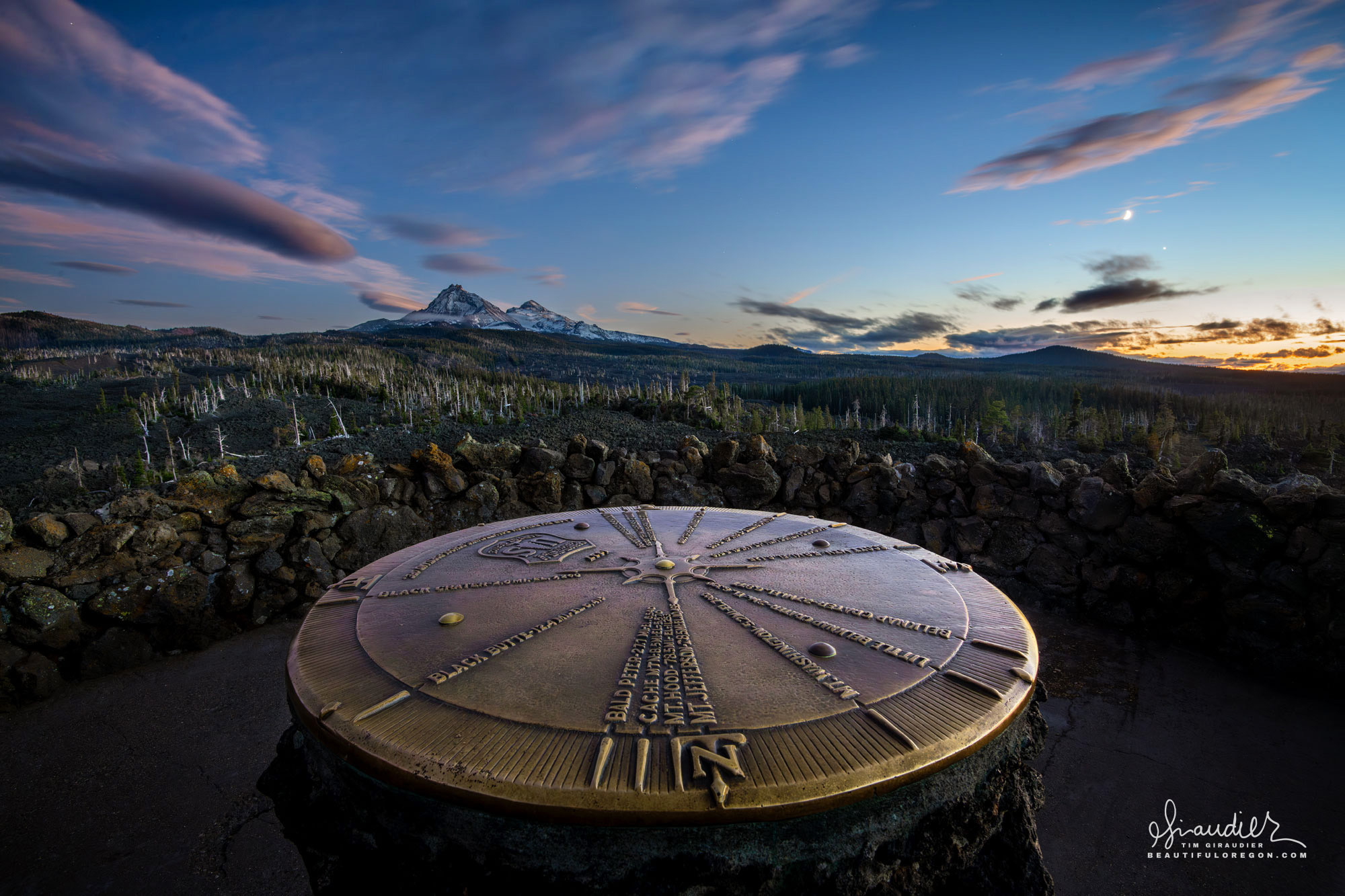
& Livraison gratuite plus de 60€Dee Wright Observatory: A Window into Oregon’s Volcanic Heart Perched atop McKenzie Pass in the central Oregon Cascades, the Dee Wright Observatory is a unique blend of human craftsmanship and raw geologic history. Constructed in 1935 by the Civilian Conservation Corps (CCC) during the height of the Great Depression, the observatory stands as both a monument to volcanic forces and a testament to the New Deal’s legacy of public works. Composed entirely of locally sourced lava rock, the structure rises organically from the surrounding landscape of hardened flows—its dark, jagged form mirroring the terrain from which it was built. The observatory is named for Dee Wright, a CCC foreman who passed away before the structure’s completion. His name is now immortalized in the very rock of Oregon’s most otherworldly overlook. From this small stone tower, visitors are offered a sweeping panorama of the Central Cascade volcanoes. Framed through carefully placed “lava tube” viewing windows are the snow-capped summits of Mount Washington, the Three Sisters, Mount Jefferson, and—on especially clear days—Mount Hood nearly 80 miles to the north. Atop the observatory, a bronze azimuth dial serves as a guide to the region’s peaks, giving context to the dramatic alpine skyline. The surrounding landscape is a dramatic testament to the region’s volcanic past. The observatory sits atop an expansive field of ʻaʻā lava, largely emplaced by eruptions from Yapoah Cone and other nearby vents during the late Holocene. The desolate, rippled surface stretches for miles in all directions, a frozen flow of dark basalt that overwhelms nearly all plant life. Despite the harshness of the terrain, life persists: hardy lichens and alpine wildflowers such as penstemon push through cracks in the lava, and wildlife has adapted to the sparse, sun-blasted conditions. The resemblance to an extraterrestrial landscape is so pronounced that NASA reportedly used this area as a training ground for astronauts in the 1960s. Adjacent to the observatory is the Lava River Interpretive Trail, a paved half-mile loop winding through the surrounding lava fields. Interpretive signs provide geological, ecological, and historical context, inviting visitors to consider both the violence of Earth’s internal forces and the resilience of the ecosystems that follow in their wake. The trail also tells the story of earlier human interactions with the area, including Indigenous presence and the later Euro-American settlers who attempted to traverse the inhospitable terrain. Oregon Route 242, the scenic highway leading to the observatory, roughly follows a 19th-century wagon route and has been designated a National Historic Place for its cultural and historical significance. Though modest in size and isolated in location, the Dee Wright Observatory offers one of the most immersive and informative volcanic viewing experiences in the Pacific Northwest. Its seasonal accessibility—typically from mid-June through early November—makes timing critical, as snow can close the pass for much of the year. During the open season, the site is popular among cyclists, stargazers, and geology enthusiasts alike. With its elevation of over 5,300 feet and minimal light pollution, the observatory also provides excellent conditions for nighttime astronomy. Today, the Dee Wright Observatory stands not only as a tribute to the region’s geologic dynamism but also as a symbol of human perseverance. It is a place where stone tells stories: of fire and flow, of work and memory, of mountain-building and sky-watching. For those who visit, it offers a rare combination of education, solitude, and sublime beauty—an enduring window into Oregon’s volcanic heart. With the North and Middle Sister in background, a 36 inch bronze azimuth points to the many peaks which surround the Dee Wright Observatory. Constructed between 1934 and 1935 by the Civilian Conservation Corps, this historic structure affords visitors a commanding view of the surrounding volcanic peaks, and is set amidst 65 square miles of forbidding lava fields. This fascinating roadside attraction is found along seasonally open, Route 242, which is itself a part of the McKenzie Pass–Santiam Pass Scenic Byway. Deschutes National Forest, Central Oregon Cascades. Dee Wright Observatory, Deschutes County, Deschutes National Forest, Highway 242, Lava, Night Photography, North Sister
Produits similaires
-
CAMERA PTZ CANON CR-N700 NOIRE $ 99.61