
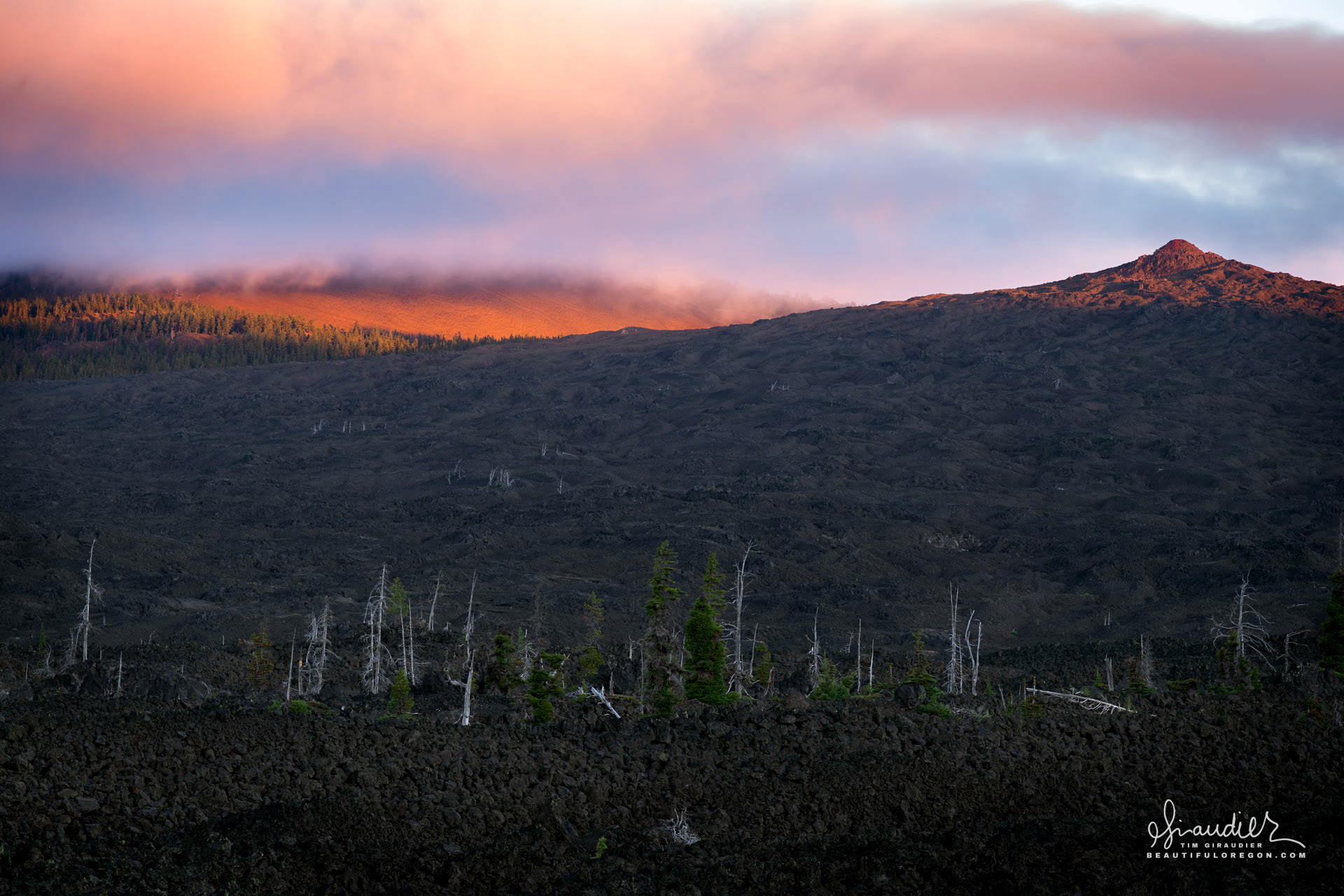
Belknap Crater and Little Belknap – Central Oregon Cascades
$ 49.50
& Livraison gratuite plus de 60€The first light of sunrise illuminates the summits of Belknap Crater and Little Belknap, while the lava fields below reside in dark shadow. Highway 242, McKenzie Pass. Deschutes National Forest, Central Oregon Cascades. Belknap Crater and its smaller satellite, Little Belknap, form a prominent volcanic complex in the central Oregon Cascades, within the Deschutes National Forest. These volcanoes are part of the High Cascades segment of the Cascade Volcanic Arc, a chain of stratovolcanoes, shield volcanoes, and volcanic fields formed by the subduction of the oceanic Juan de Fuca Plate beneath the continental North American Plate. Belknap Crater is a Holocene-age basaltic shield volcano that represents one of the most recent and well-preserved volcanic centers in the central Cascades. The main eruptive phase occurred approximately 1,500 years ago, around 460 CE, during a period of activity that produced extensive basaltic lava flows and a central pyroclastic cone. These lava flows, which emanated from the main vent and associated fissures, now blanket more than 40 square kilometers of the McKenzie Pass region. The lavas are primarily pāhoehoe and ‘a‘ā types—terms derived from Hawaiian volcanology to describe smooth, ropy lava and rough, clinkery lava, respectively—indicating low-viscosity magma typical of basaltic effusive eruptions. The central feature of Belknap is a scoria cone composed of loose fragments of volcanic rock (scoria) erupted explosively early in the volcano’s history. Subsequent lava flows spilled out and overran surrounding terrain, burying older landforms and contributing to the broad, shield-like profile of the volcano. The flows extended several kilometers in multiple directions, reshaping the local topography and in some places damming streams and altering drainage patterns. Radiocarbon dating of charcoal beneath some flows confirms the eruptions took place entirely within the late Holocene, making Belknap one of the youngest volcanic features in Oregon outside of the Newberry and Mount Bachelor volcanic systems. Little Belknap, situated to the southwest of the main cone, is a smaller parasitic vent that predates the main Belknap eruptions by a few hundred years. Though less prominent, Little Belknap contributed significantly to the regional lava field, with its own set of voluminous basalt flows. The landscape surrounding Little Belknap, including lava tubes, collapsed skylights, and pressure ridges, preserves excellent examples of surface features associated with basaltic shield volcanism. Both Belknap and Little Belknap are classified as monogenetic volcanoes—meaning each experienced a relatively short-lived eruptive history, possibly lasting a few years to decades, before becoming inactive. Their formation is part of the broader volcanic evolution of the High Cascades, which in this area shows a transition from the older, eroded Western Cascades to the younger, constructionally active volcanic terrain to the east. Today, the lava fields remain sparsely vegetated, with only scattered lodgepole pine, mountain hemlock, and hardy subalpine species taking root on the thin, undeveloped soils. The freshness of the terrain, along with its accessibility via the McKenzie Pass Scenic Byway and Pacific Crest Trail, makes Belknap Crater a striking example of youthful volcanism in the Pacific Northwest, and a key site for understanding the eruptive history and geomorphology of the central Oregon Cascades. Belknap Crater, Central Oregon Cascades, Deschutes County, Deschutes National Forest, Highway 242, Lava, Sunrise